



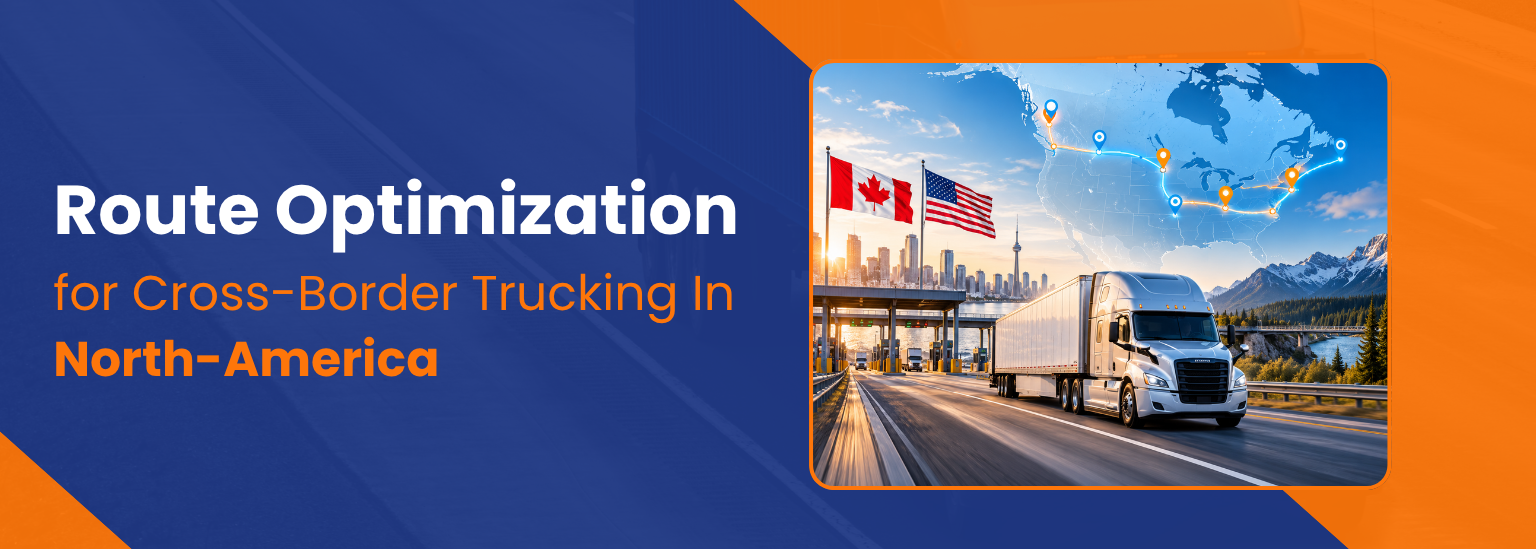
Route Optimization for Cross-Border Trucking In North-America
- October 26, 2026
- AVAAL Technology Solutions
Moving freight between Canada and the United States involves more than choosing the fastest route on a map. Trucking companies must coordinate delivery schedules, monitor traffic, plan fuel stops, manage driver hours, prepare customs documentation, and account for potential delays at the border.
Even a well-planned trip can be disrupted by a busy port of entry, incomplete paperwork, changing road conditions, or an unexpected delay at a pickup location. For carriers managing multiple trucks and deliveries, these disruptions can affect the entire dispatch schedule.
When combined with effective transportation management and customs documentation processes, these tools can support more efficient freight movement between Canada and the US.
For carriers looking to improve overall transportation efficiency, AVAAL Freight Management Suite provides an integrated approach to managing freight operations, with transportation capabilities highlighted on its platform.
In this article, we explore how cross-border trucking route optimization works, the challenges it can help address, and what trucking companies should consider when implementing it.
What Is Cross-Border Trucking Route Optimization?
Cross-border trucking route optimization is the process of identifying suitable routes for freight moving between Canada and the United States while balancing travel time, operating costs, delivery commitments, and regulatory requirements.
Traditional route planning often relies on maps, dispatcher experience, and estimated travel times. These methods remain useful, but they may not account for every factor affecting a cross-border shipment.
Depending on the software and available data, these variables may include:
- Distance and estimated driving time
- Traffic conditions and road closures
- Border crossing locations and expected delays
- Pickup and delivery time windows
- Driver availability and hours-of-service limits
- Vehicle dimensions, weight, and route restrictions
- Fuel costs and planned refuelling stops
- Shipment priorities and customer commitments
For example, a carrier transporting goods from Toronto to Chicago may consider more than the shortest driving route. The dispatcher must also account for the selected border crossing, customs readiness, delivery appointment, driver schedule, and conditions along the journey.
Why Cross-Border Trucking Requires More Than Basic GPS Navigation
GPS navigation helps drivers follow roads and respond to traffic conditions. Cross-border freight operations, however, require coordination between transportation planning, dispatch, customs documentation, and customer delivery requirements.
Several factors make these shipments more complex.
1. Border Crossing Delays and Uncertainty
Border wait times can vary depending on traffic volumes, inspection activity, time of day, weather, and operational conditions at individual ports of entry.
A route that appears fastest under normal conditions may become less attractive when congestion increases. Dispatchers may need to compare alternative crossings or revise departure times while considering the additional distance and cost involved.
Carriers should also remember that a shorter estimated queue does not automatically make an alternative crossing the better choice. Road suitability, operating hours, shipment requirements, customs readiness, and the driver’s schedule must all be considered.
2. Customs Documentation and Shipment Readiness
A truck can arrive at the border on time and still experience delays if its documentation is incomplete, inaccurate, or not properly processed.
Commercial carriers moving goods into Canada must meet applicable advance information requirements through the Canada Border Services Agency’s Advance Commercial Information (ACI) programme. US-bound movements have their own requirements through US Customs and Border Protection’s Automated Commercial Environment (ACE).
The CBSA explains that highway carriers transporting goods into Canada must have the required cargo and conveyance data transmitted and validated at least one hour before arrival, subject to applicable rules and exceptions. Accurate information helps reduce avoidable processing delays.
Carriers can review the official CBSA highway carrier requirements for transmitting electronic commercial data and US Customs and Border Protection’s ACE resources for further guidance.
Route planning and customs preparation should therefore work together. Dispatchers need to know whether a shipment is ready for its planned crossing, while the documentation team needs accurate shipment and conveyance details.
Dedicated ACE/ACI eManifest software can help carriers manage electronic manifest submissions and related shipment information.
3. Delivery Appointments and Customer Commitments
Cross-border shipments frequently operate within specific pickup and delivery windows. A delay at the border can affect warehouse appointments, customer schedules, driver availability, and subsequent loads.
For example, a truck travelling from Mississauga to a distribution centre in Michigan may have a fixed delivery appointment. If the expected border crossing takes longer than anticipated, the dispatcher may need to update the customer, coordinate a revised arrival time, and reconsider the driver’s next assignment.
Route optimization can help dispatchers assess the impact of different travel scenarios. Instead of considering distance alone, they can evaluate whether a proposed route remains practical within the available delivery window.
The result is a more informed planning process, although actual arrival times will still depend on road conditions, border processing, and other factors outside the carrier’s control.
4. Fuel Costs and Unnecessary Mileage
Fuel remains an important operating expense for trucking companies. Additional mileage caused by poor planning, missed turns, avoidable detours, or inefficient scheduling can increase costs and reduce the time available for productive trips.
AI-assisted route planning can help compare routes based on distance, expected travel time, and other relevant operating factors. Where supported, it may also help coordinate fuel stops and identify opportunities to reduce unnecessary mileage.
However, the shortest route is not always the most economical. A slightly longer route may offer better road conditions, fewer congestion points, or more practical fuel stops. Vehicle restrictions and driver schedules can also affect which option makes the most sense.
Fuel efficiency is another important consideration. Carriers can also explore practical ways to reduce empty miles and fuel costs when planning trips and coordinating return loads.
5. Driver Hours and Route Restrictions
Cross-border trip planning must account for applicable driver hours-of-service requirements, rest periods, vehicle restrictions, and other operating rules.
A route that appears efficient on a map may not be practical if it requires the driver to exceed permitted driving limits or leaves insufficient time for mandatory rest.
Likewise, commercial vehicles may be restricted from using certain roads, bridges, or local routes because of vehicle dimensions, weight, or other requirements.
An effective route optimization process should account for these constraints wherever supported by the software and verified data. Dispatchers must still confirm that the planned trip complies with applicable regulations and that the route is suitable for the specific vehicle and shipment.
How Route Optimization Works in Cross-Border Trucking
Route optimization can support several stages of transportation planning. Its actual capabilities depend on the platform, the quality of the data it receives, and how it is integrated into the carrier’s workflow.
Step 1: Collect Shipment and Vehicle Information
The process begins with information about the load, including pickup and delivery locations, cargo requirements, delivery deadlines, and any special handling considerations.
Dispatchers may also need to consider the assigned driver, vehicle type, available equipment, current location, and remaining driving hours.
Bringing this information together helps establish which routes are feasible before comparing their relative efficiency.
Step 2: Evaluate Potential Routes
The system evaluates possible routes using the information available to it. Depending on its capabilities, this may include road networks, traffic conditions, estimated travel times, fuel considerations, and restrictions affecting commercial vehicles.
For cross-border trips, the dispatcher may also need current information about the intended port of entry and the shipment’s customs readiness.
Step 3: Compare Routes Against Delivery Requirements
The fastest route is not necessarily the best route for a particular shipment.
A dispatcher must consider the delivery appointment, available driving hours, planned rest periods, border processing requirements, and the consequences of arriving too early or too late.
Route optimization can help compare alternatives against these constraints and identify plans that better fit the shipment’s requirements.
Step 4: Monitor Changes During the Trip
Conditions may change after a truck has departed. Congestion, road closures, severe weather, loading delays, or other disruptions may make the original plan less suitable.
When the system receives timely and reliable updates, it may help dispatchers evaluate alternative routes or revise the estimated arrival time.
Not all transportation platforms offer the same real-time capabilities, and not every disruption can be resolved through rerouting. For example, changing roads will not resolve missing customs documentation or a mandatory inspection.
Step 5: Review Performance After Delivery
Once the shipment is complete, carriers can compare the original plan with the actual trip.
Useful measures include:
- Planned versus actual travel time
- Distance travelled
- Fuel consumption and cost
- On-time pickup and delivery rates
- Unplanned stops and route deviations
- Border-related delays, where reliable records are available
Reviewing this information can help identify recurring problems and improve future planning decisions.
Key Benefits of Route Optimization for Cross-Border Carriers
When implemented appropriately, AI-assisted route optimization can help carriers improve planning and make better use of operational information.
Better Visibility for Dispatchers
A clear view of shipment status, driver assignments, planned routes, and delivery schedules helps dispatchers coordinate daily activities.
When transportation information is available through connected systems, teams can more easily identify potential conflicts and determine which shipments need attention.
More Informed Decisions About Border Crossings
Comparing alternative routes and crossings can help dispatchers make decisions based on available information rather than relying only on habitual routes or static travel estimates.
The quality of this decision-making depends on whether the system has relevant and current data. Border conditions can change quickly, so estimates should be treated as planning inputs rather than guarantees.
Improved Delivery Planning
By considering delivery windows, estimated travel times, driver schedules, and route constraints together, carriers can create more realistic trip plans.
This can help teams identify scheduling conflicts earlier and communicate potential changes to customers before they become more disruptive.
Better Fuel and Mileage Management
Route planning that considers distance, road conditions, and operating costs may help reduce unnecessary travel.
Over time, comparing planned and actual mileage can also help carriers identify routes or processes that consistently contribute to higher operating costs.
More Coordinated Transportation Workflows
Cross-border transportation involves more than the driver and dispatcher. Documentation teams, customs brokers, customers, and other partners may also need timely and accurate information.
Connecting transportation workflows with shipment documentation and status information can reduce reliance on repeated manual updates and make it easier for teams to coordinate their work.
These benefits depend on the features available in the software, the accuracy of the underlying information, and how consistently the business uses the system.
Why Transportation Management and eManifest Software Should Work Together
Route optimization is only one part of managing a cross-border shipment. Carriers must also coordinate dispatch, shipment records, customs documentation, and delivery updates.
When these activities are handled through disconnected tools, employees may need to re-enter information or contact colleagues to confirm the status of a load. This can make it harder to maintain an accurate view of the shipment.
An integrated transportation workflow helps connect operational planning with the information needed to move freight across the border.
For example, before dispatching a Canada-to-US shipment, a carrier may need to confirm the pickup schedule, assign a suitable driver and vehicle, ensure the required documentation has been prepared, and plan an appropriate route.
As the trip progresses, dispatchers may need to monitor shipment status, respond to changing conditions, and update the customer if the expected arrival time changes.
This is where transportation management and eManifest tools can complement one another.
AVAAL Transportation Management Software brings together transportation management capabilities for dispatch, freight operations, tracking, and compliance workflows through its software suite.
For the customs documentation side of cross-border operations, AVAAL ACE/ACI eManifest Software supports electronic manifest filing for US and Canadian border movements, along with related shipment status and notification capabilities.
The two areas serve different purposes: transportation management helps coordinate the trip, while eManifest tools support the required electronic customs documentation processes. Using appropriate tools for both can help carriers organize their operations more effectively.
How to Choose Route Optimization Software for Cross-Border Trucking
Before investing in route optimization technology, trucking companies should evaluate how well the software supports their actual routes, vehicles, and operational processes.
1. Check the Quality of Routing Data
Ask which information the system uses to calculate routes and estimated travel times. Determine whether it supports current traffic information, commercial vehicle restrictions, and the types of road and border data your operation requires.
Do not assume that every AI-enabled platform has access to live border wait times or reliable predictive information.
2. Evaluate Commercial Vehicle Requirements
Confirm that the routing process can account for the dimensions and weight of your vehicles, applicable road restrictions, and relevant driver operating limits.
These requirements are particularly important when planning routes for specialised equipment or shipments with specific transport conditions.
3. Consider Dispatch and TMS Integration
Route planning is more useful when dispatchers can connect it with load assignments, driver schedules, shipment status, and delivery requirements.
Review whether the software integrates with your existing transportation management system and whether information can be shared without repeated manual entry.
4. Review Customs Documentation Workflows
For Canada-US operations, confirm how the system fits into your existing ACE/ACI eManifest process.
Determine whether shipment details can be transferred between systems, which tasks still require manual handling, and how your team will confirm that the required information has been accepted.
Carriers should verify current filing requirements directly with the relevant customs authorities and their customs brokers.
5. Measure Performance Before and After Implementation
Establish a baseline before evaluating the results of a new system. Track metrics such as fuel cost per kilometre, empty-mile percentage, on-time delivery rate, and average trip duration.
Where possible, compare similar routes, shipment types, and operating conditions. This provides a more meaningful assessment than relying on a single trip or a general claim about potential savings.
6. Make Sure Dispatchers Can Use the System Effectively
Even capable technology needs to fit the way your team works. Consider the training required, the ease of updating shipment information, the availability of technical support, and how employees will handle exceptions that the software cannot resolve automatically.
A practical solution should help dispatchers make decisions, not create additional administrative work.
Final Thoughts
Cross-border trucking between Canada and the United States requires careful coordination of routes, drivers, delivery schedules, fuel costs, and customs documentation. When these activities are managed separately, it can be difficult for dispatchers to maintain a clear picture of the shipment and respond quickly when conditions change.
AI-assisted route optimization offers a way to evaluate routing options, account for more operational constraints, and make better-informed planning decisions. Its value depends on the quality of the available data, the capabilities of the software, and how effectively it fits into existing transportation workflows.
For the best results, carriers should treat route optimization as part of a broader approach to transportation management rather than as a standalone solution. Connecting dispatch planning with shipment visibility and customs documentation can help teams manage cross-border freight with greater consistency.
If your business is looking to improve transportation planning and coordinate freight operations more effectively, explore AVAAL Transportation Management Software.
Frequently Asked Questions
What is cross-border trucking route optimization?
Cross-border trucking route optimization is the process of selecting practical routes for freight travelling between Canada and the United States while considering travel time, operating costs, delivery schedules, vehicle restrictions, and border-related requirements.
AI-assisted tools can help compare route options and assess how changing conditions may affect a trip.
Why is eManifest important for cross-border trucking?
Electronic manifests provide customs authorities with required advance cargo and conveyance information. Carriers must comply with the applicable filing requirements and timelines for the direction of travel.
Accurate, complete, and timely information helps customs authorities process shipment details and can reduce avoidable delays caused by documentation errors.
Can transportation management software support cross-border operations?
Yes, depending on the platform. Transportation management software can help coordinate loads, dispatch, shipment tracking, and operational information. Separate or integrated eManifest capabilities may support the customs documentation required for cross-border movements.
Carriers should confirm that the software supports the specific workflows and regulatory requirements relevant to their business.
- October 23, 2026


- October 9, 2026

- December 15, 2025


- December 19, 2024


- May 10, 2024
