



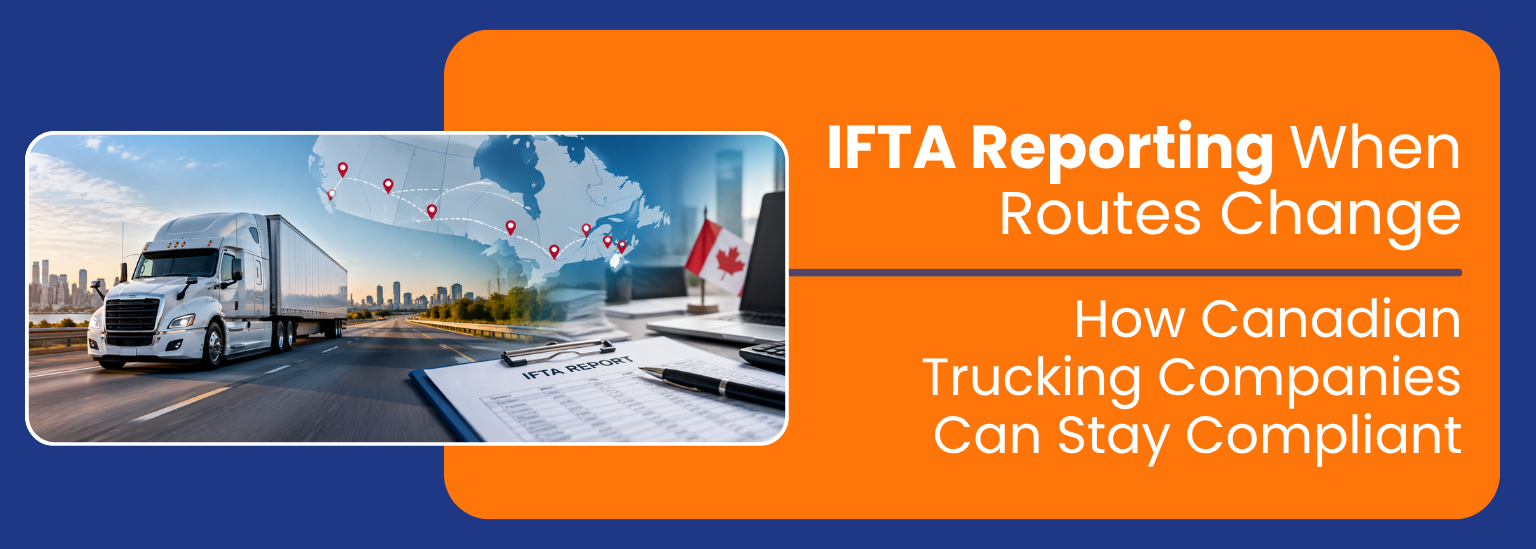
IFTA Reporting When Routes Change: How Canadian Trucking Companies Can Stay Compliant
- October 9, 2026
- AVAAL Technology Solutions
For Canadian trucking companies, routes rarely stay exactly as planned.
A driver may leave Ontario for Alberta and take a different route because of road construction. A delivery may be added in another province. A customer may change a pickup location. A cross-border load may send a truck into the United States before it returns to Canada.
These changes are part of everyday trucking operations. They can also create additional work when it is time to prepare an IFTA fuel tax return.
IFTA reporting is based on where a qualified vehicle actually travels and the fuel purchased during the reporting period. When actual travel differs from the planned route, carriers need accurate records to make sure the mileage and fuel information is assigned to the correct jurisdiction.
For Canadian carriers operating across provinces and U.S. states, having a consistent process for tracking these changes can make quarterly IFTA reporting much easier.
What Is IFTA?
The International Fuel Tax Agreement, commonly known as IFTA, is an agreement between participating U.S. states and Canadian provinces that simplifies fuel tax reporting for qualifying commercial motor carriers operating across jurisdictions.
Instead of filing separate fuel tax reports in every jurisdiction where a truck travels, an eligible carrier generally files one consolidated quarterly return through its base jurisdiction.
The return is based on information such as:
- Total kilometres or miles travelled
- Distance travelled in each jurisdiction
- Fuel purchased
- Fuel consumed
- Fuel taxes paid
- Applicable jurisdictional tax rates
The result determines whether the carrier owes additional fuel tax or is entitled to a credit.
For Canadian trucking companies, IFTA can simplify the reporting process, but it does not remove the need for accurate records.
Why Route Changes Create IFTA Challenges
A planned route provides a starting point for dispatch. IFTA reporting, however, needs to reflect the vehicle’s actual travel.
Consider a truck scheduled to travel from Toronto to Winnipeg. The planned route may pass through Ontario, Michigan, and Wisconsin before entering Manitoba.
During the trip, the driver may be redirected because of weather, road restrictions, traffic, a customer request, or a new pickup.
The truck may travel additional distance through another state or province.
That extra distance matters.
If the carrier records only the original route, the final mileage report may not accurately represent where the vehicle travelled during the reporting period.
This can create discrepancies between:
- Dispatch records
- GPS or telematics data
- ELD records
- Odometer readings
- Fuel receipts
- Fuel card transactions
- IFTA mileage reports
The more frequently a fleet’s routes change, the more important it becomes to keep these records consistent.
Planned Mileage Is Not Always Actual Mileage
One of the most common problems with route-based IFTA reporting is relying too heavily on planned mileage.
A dispatch system may show the route that was originally assigned to a driver. A GPS system may show the route the driver actually followed. Those two records may not always match.
For IFTA purposes, the actual distance travelled is what matters.
A driver may:
- Take a detour around construction
- Travel through a different province
- Cross into a U.S. state that was not part of the original plan
- Make an additional customer stop
- Return to a previous location
- Change routes because of weather
- Take an alternate highway because of restrictions
Each change can affect the jurisdictional mileage record.
This is why Canadian carriers should avoid treating a planned route as the final IFTA record.
How Route Changes Can Affect Your IFTA Return
IFTA reporting involves more than simply adding up the kilometres or miles driven during a quarter.
The carrier needs to allocate the vehicle’s travel to the appropriate jurisdictions and account for fuel purchased during the reporting period.
A route change can affect both sides of that calculation.
For example, imagine a truck travels from British Columbia to Ontario. The driver originally plans one route but later takes an alternate route through another jurisdiction.
The additional kilometres travelled through that jurisdiction need to be reflected in the carrier’s records.
If the fuel purchase records remain accurate but the mileage is assigned incorrectly, the final IFTA calculation may not accurately reflect the truck’s actual operation.
The same issue can happen in reverse: mileage may be correct while fuel records are incomplete or difficult to reconcile.
That is why mileage and fuel information should be reviewed together.
6 IFTA Records Canadian Carriers Should Keep Organized
A reliable IFTA process starts with good records.
1. Jurisdictional Mileage
Keep accurate records of the distance travelled in each IFTA jurisdiction.
GPS, ELD, telematics, and other fleet systems can help capture this information without requiring drivers or office staff to manually record every kilometre.
2. Fuel Purchases
Maintain records of fuel purchases, including the date, location, quantity, and other required transaction details.
Fuel card records can make this easier because transactions can be collected digitally instead of relying entirely on paper receipts.
3. Vehicle Information
Keep your fleet information current.
Changes to vehicles, registrations, ownership, or other business details should be reflected in your compliance records where applicable.
4. Trip and Dispatch Records
Dispatch records can provide useful supporting information when a route changes.
If an unusual trip appears in your mileage report, dispatch records can help explain why the vehicle travelled differently from the original plan.
5. ELD and Telematics Data
Electronic records can provide valuable evidence of where a vehicle travelled.
When mileage information is captured electronically, it can also reduce the amount of manual data entry required by your operations team.
6. Fuel Receipts and Supporting Documents
Do not overlook supporting documentation.
If there is a discrepancy between mileage and fuel data, the original receipts and transaction records can help your team investigate and correct the issue before filing.
What Happens When a Driver Takes an Unexpected Detour?
Unexpected detours should not be ignored simply because they are relatively short.
Suppose a driver takes a 30-kilometre detour through another jurisdiction because of an accident on the planned route.
That distance still forms part of the vehicle’s actual travel.
A good IFTA process should capture the change automatically where possible. If the system does not capture it correctly, the carrier should review the available records and make the necessary correction before preparing the quarterly return.
The key principle is simple:
Report where the truck actually travelled, not only where it was originally supposed to travel.
Fuel Purchases and Mileage Need to Match
Mileage is only one part of IFTA reporting.
Fuel information is equally important.
A carrier may have accurate jurisdictional mileage but still encounter problems if fuel purchases are missing, duplicated, or assigned incorrectly.
For example, a driver may fuel in one province, travel through another, and finish the trip in a third jurisdiction.
The fuel purchase location and the kilometres travelled are separate pieces of information, and both need to be recorded correctly.
This is why relying on a pile of paper receipts at the end of a quarter can create unnecessary work.
A better process is to capture fuel transactions throughout the quarter and reconcile them against vehicle and trip records on a regular basis.
Don’t Wait Until Quarter-End to Check Your Records
One of the easiest ways to make IFTA reporting more difficult is to leave all the reconciliation work until the end of the quarter.
By then, a missing receipt or unusual trip from several months ago may be difficult to investigate.
Instead, Canadian carriers can benefit from a regular review process.
Monthly IFTA Review
At least once a month, review:
- Jurisdictional mileage
- Fuel purchases
- Missing fuel records
- Duplicate transactions
- Unusual mileage
- Route exceptions
- Vehicle records
- Differences between odometer and electronic mileage
This gives your team an opportunity to resolve problems while the information is still recent.
A monthly review also makes the final quarterly filing less stressful.
What If the Route Changes After the Trip Is Complete?
Sometimes a route issue is not identified until after the truck has completed the trip.
This does not mean the record should simply be left as it is.
Start by reviewing the available information.
Useful sources can include:
- GPS history
- ELD records
- Telematics data
- Dispatch records
- Fuel receipts
- Fuel card transactions
- Odometer readings
- Driver trip records
Use the available information to establish where the vehicle travelled and identify any discrepancies.
If a mileage correction is required, keep a clear record explaining the adjustment and the information used to support it.
Good documentation is particularly important when records may later need to be reviewed during an audit.
Technology Can Make IFTA Reporting Easier
Manual IFTA reporting becomes increasingly difficult as a fleet grows.
A carrier managing a few vehicles may be able to reconcile records using spreadsheets and receipts. A larger fleet can generate thousands of transactions and significant amounts of mileage data every quarter.
Technology can help by bringing information from different parts of the operation together.
For example, carriers may use:
- ELD systems for vehicle activity
- GPS and telematics for location and mileage
- Fuel cards for fuel transactions
- Dispatch software for trip information
- Accounting systems for financial records
- IFTA reporting tools for tax calculations
The goal is not simply to collect more data.
The goal is to make the data work together.
When mileage, fuel, vehicle, and trip information can be reviewed in a connected workflow, it becomes easier to identify discrepancies before they become quarterly reporting problems.
A Practical IFTA Checklist for Canadian Trucking Companies
Before submitting an IFTA return, review the following:
Registration
- Is your IFTA account active?
- Is your base jurisdiction information current?
- Are your qualified vehicles properly registered?
- Are your IFTA credentials and decals current?
Mileage
- Does total mileage agree with your vehicle records?
- Is mileage allocated to the correct jurisdictions?
- Have route changes and detours been accounted for?
- Are there any missing or duplicate trips?
Fuel
- Are all fuel purchases recorded?
- Do fuel records match receipts or fuel card transactions?
- Are fuel purchases assigned to the correct locations?
- Are there unusual fuel transactions that need review?
Reconciliation
- Have mileage and fuel records been compared?
- Have discrepancies been investigated?
- Are supporting records available?
- Have corrections been documented?
Filing
- Are you using the applicable reporting period and current requirements?
- Has the return been reviewed before submission?
- Are copies of the return and supporting records retained?
This checklist can help make quarterly IFTA preparation more consistent and less reactive.
Common IFTA Mistakes to Avoid
Using Planned Routes Instead of Actual Routes
A dispatch plan does not always reflect the route a truck actually travelled. Make sure your final records reflect actual vehicle activity.
Waiting Until the Deadline
Last-minute reconciliation leaves little time to investigate missing or inconsistent records.
Relying Only on Fuel Receipts
Receipts show fuel purchases, but they do not provide the complete mileage picture. Fuel information needs to be considered alongside vehicle and trip records.
Ignoring Small Route Changes
A short detour can still affect jurisdictional mileage. Do not assume that a route change is too small to matter.
Mixing Records From Different Vehicles
Make sure fuel and mileage information is tied to the correct vehicle. Errors can occur when records are manually transferred between spreadsheets or systems.
Failing to Keep Supporting Documentation
Your IFTA return should be supported by the records used to prepare it. Organised documentation makes it easier to answer questions later.
How AVAAL Helps With IFTA Compliance
Managing IFTA registration and ongoing reporting can take valuable time away from running a trucking business.
AVAAL Technology Solutions provides IFTA registration, renewal, and fuel tax filing services for carriers operating across Canada and the United States.
AVAAL supports carriers with the registration process, including application preparation, IFTA licensing and decals, renewals, quarterly fuel tax reporting, and ongoing compliance support.
For a carrier dealing with changing routes, multiple jurisdictions, fuel records, and quarterly filing requirements, professional support can reduce the administrative burden and help keep compliance records organised.
AVAAL also provides transportation technology and trucking management software that can support broader fleet and operational workflows.
Make IFTA Reporting Part of Your Regular Fleet Process
Route changes are a normal part of trucking. IFTA problems often arise when those changes are not reflected in the records used for quarterly reporting.
The solution is not to eliminate route changes. That is rarely practical.
Instead, carriers should establish a process that captures actual mileage, records fuel purchases accurately, reconciles information regularly, and keeps supporting documentation organised.
For Canadian trucking companies operating across provinces or across the Canada-U.S. border, a consistent IFTA process can make quarterly reporting more manageable and reduce the risk of avoidable errors.
Frequently Asked Questions
1. Do route changes affect IFTA reporting?
Yes. IFTA reporting should reflect the actual distance a qualified vehicle travels in each jurisdiction during the reporting period. Detours, alternate routes, additional stops, and other changes can affect the mileage that a carrier reports.
2. How do Canadian trucking companies track mileage for IFTA?
Canadian carriers can use ELDs, GPS, telematics, odometer records, and trip documentation to track vehicle mileage. These records can help determine the actual distance travelled in each IFTA jurisdiction and support accurate quarterly reporting.
3. What happens if a driver takes an unexpected route?
An unexpected route should be reflected in the carrier’s mileage records. The carrier can review GPS, ELD, dispatch, and other trip records to confirm where the vehicle travelled and update the jurisdictional mileage used for the IFTA return.
4. How often should trucking companies review IFTA records?
Carriers should review their mileage and fuel records regularly rather than waiting until the quarterly filing deadline. A monthly review can help identify missing fuel transactions, mileage discrepancies, route changes, and other issues while the trip information is still easy to verify.
5. Can AVAAL help with IFTA registration and reporting?
Yes. AVAAL provides IFTA registration, renewal, and fuel tax filing services for trucking companies operating across Canada and the United States. Its services help carriers manage IFTA requirements and keep their fuel tax reporti

- October 9, 2026


- December 15, 2025


- December 19, 2024


- May 10, 2024
