
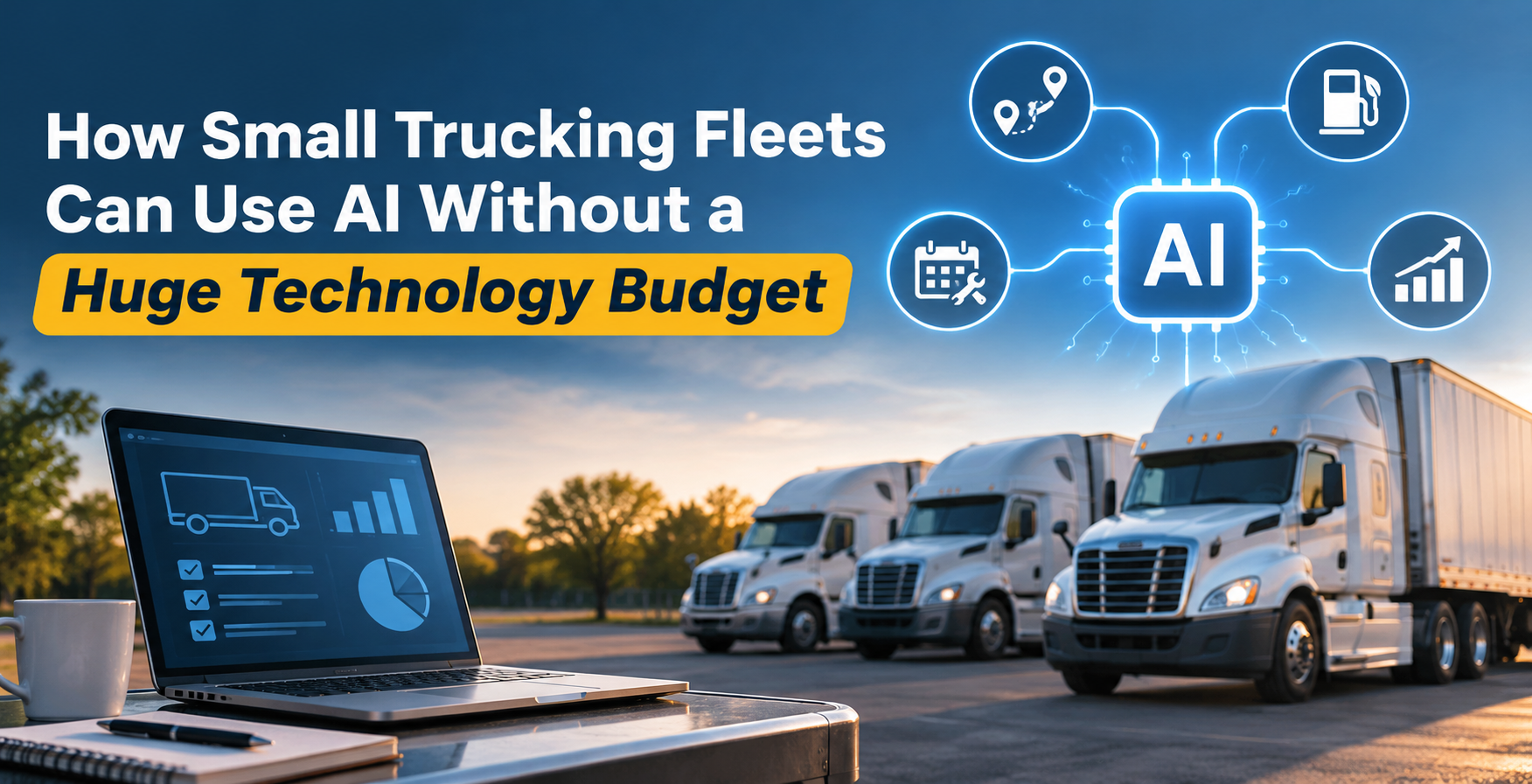
How Small Trucking Fleets Can Use AI Without a Huge Technology Budget
- November 2, 2026
- AVAAL Technology Solutions
For a small trucking fleet, every dollar matters. When you are managing drivers, dispatching loads, dealing with customers, tracking paperwork and trying to keep trucks moving, investing thousands of dollars in complicated new technology may not sound realistic. Using artificial intelligence in trucking no longer requires a large IT department or an enterprise-sized technology budget.
Today, small trucking fleets can use AI through modern trucking management software to automate repetitive work, improve dispatch decisions, reduce manual data entry and get more useful information from the data they already have.
Instead of buying several separate AI tools, the smarter approach is often to choose a freight management platform that already has AI built into everyday trucking operations.
Here is how small and growing fleets can put AI to work without turning technology into another major expense.
AI for Trucking Is Becoming More Practical for Small Fleets
When people hear “artificial intelligence,” they often think about expensive systems used by large corporations.
That is not how most trucking companies need to use AI.
For a fleet with five, ten or twenty trucks, AI does not need to drive the entire business. Its value comes from handling small, repetitive tasks that take up time every day.
Think about how many minutes your team spends entering information from rate confirmations, assigning loads, checking delivery information, looking for invoices, preparing reports or switching between different systems.
Saving a few minutes on each task can add up quickly.
This is where AI-powered trucking management software becomes valuable. Rather than adding another complicated piece of software, AI can work inside the systems dispatchers and fleet managers already use.
Reduce Manual Order Entry
One of the easiest places for a trucking company to start using AI is load and order entry.
A dispatcher may receive a rate confirmation containing pickup information, delivery details, customer information, rates and other instructions. Traditionally, someone has to read the document and manually enter that information into a transportation management system.
It works, but it takes time and creates opportunities for typing errors.
AI can help read documents and convert the information into an order automatically.
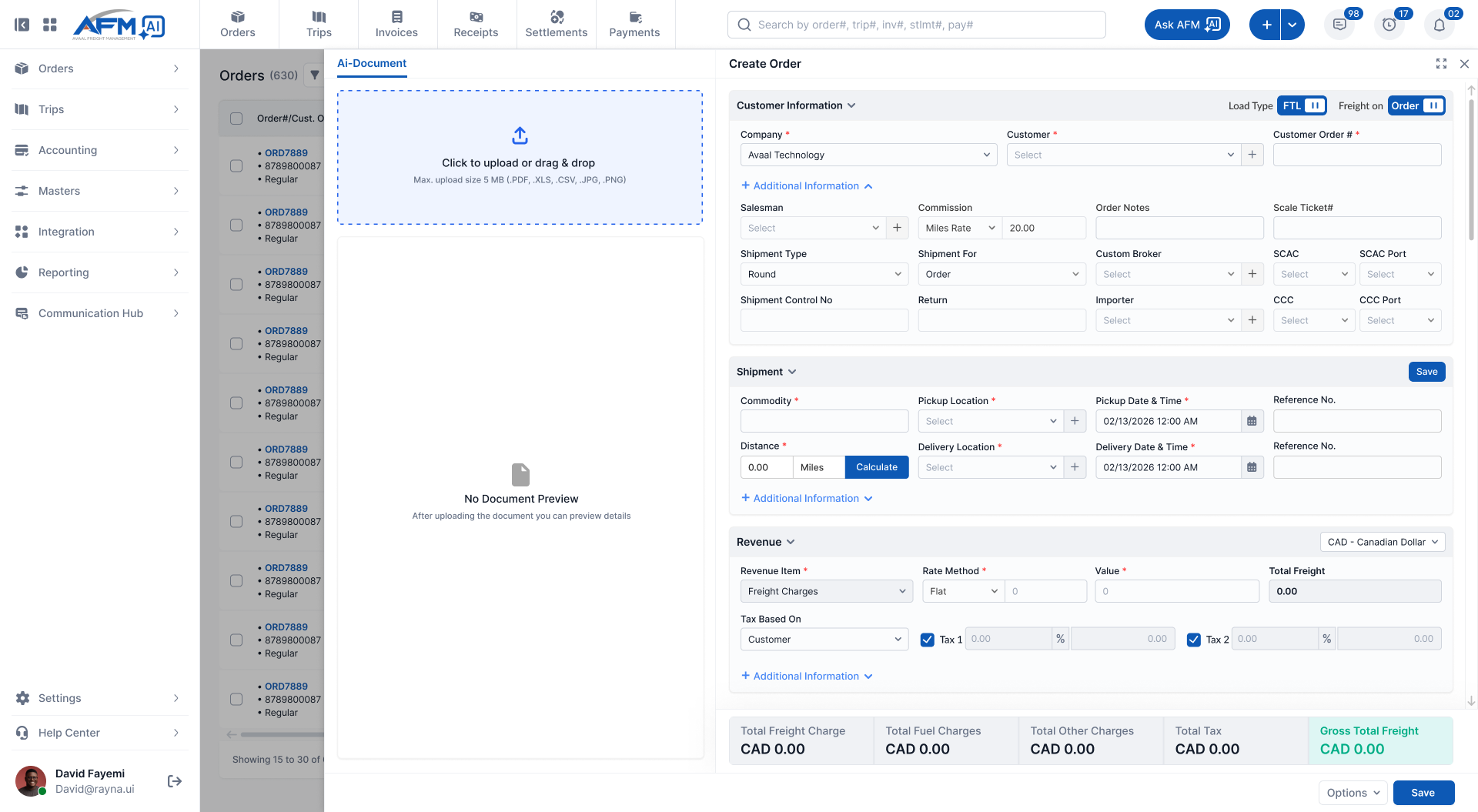
For example, AVAAL Freight Management includes Order-X, an AI feature that reads rate confirmations and builds orders without requiring dispatchers to re-enter every shipper, stop and rate manually.
For a small fleet, that does not simply mean using “advanced AI.” It means spending less time typing and more time managing loads and customers.
Use AI Dispatch to Plan Loads Faster
Dispatching is another area where small trucking fleets can benefit from AI.
Dispatchers constantly balance several factors: available trucks, driver schedules, pickup times, delivery windows, routes and customer requirements.
When information is spread across spreadsheets, text messages and different applications, even straightforward decisions can take longer than they should.
Modern freight management software can bring load information, trucks, drivers and trips together in one place. AI and automation can then help dispatchers work through that information more efficiently.
AVAAL Freight Management combines order management, trip planning, intelligent dispatch, routing and real-time freight visibility within its platform.
The goal is not to replace the dispatcher.
Experienced dispatchers understand customers, drivers and real-world problems in a way software cannot fully reproduce. AI is more useful when it gives dispatchers better information and removes administrative work so they can make decisions faster.
Spend Less Time Searching Through Reports
Small fleet owners often have plenty of business data but not enough time to analyze it.
You may want to know which customers owe the most money, which delivered loads have not been invoiced, which customers generate the most revenue or how certain parts of the operation are performing.
Finding those answers may involve opening several reports or working through spreadsheets.
AI assistants can make that process simpler.
AVAAL’s AFM AI Freight Assistant, for example, allows users to ask questions about operational records in plain language and receive information based on their freight data. Users can ask in plain language and get insight on customers, drivers, lanes and trucks.
For a small fleet owner who does not have a dedicated analyst, this type of capability can make business information easier to access.
Instead of learning how to build another report, you can focus on the question you actually need answered.
Automate Invoicing and Back-Office Work
Moving freight is only part of running a trucking company.
You also have to invoice customers, track receivables and payables, manage settlements, monitor expenses and keep financial records organized.
Those administrative jobs become increasingly difficult as the fleet grows.
Automation can help reduce some of the repetitive steps between completing a load and getting paid.
An integrated transportation management system can connect orders, trips, invoices and accounting instead of requiring the same information to be entered several times.
AVAAL Freight Management includes automated invoicing and settlements, receivables and payables posted directly to accounting, expense control and reporting within the same freight platform.
For a smaller carrier, the benefit is straightforward: fewer disconnected processes for the office team to manage.
Use AI With the Technology You Already Have
One mistake small trucking companies can make is assuming that adopting better technology means replacing everything they currently use.
That can make a technology project unnecessarily expensive.
A better approach is to look for trucking software that can connect with existing systems.
Your fleet may already use an ELD, GPS system, fuel card, accounting program or load board. If your freight management platform can integrate with those tools, you may be able to improve your operation without rebuilding it from scratch.
AVAAL supports integrations with API-enabled third-party services including ELD and GPS platforms, accounting systems, fuel cards, load boards and EDI partners. Its listed integrations include platforms such as Motive, Samsara, Geotab, QuickBooks and several trucking visibility and fuel systems.
This matters particularly for smaller fleets because integration can reduce duplicate data entry while allowing the business to keep using tools that already work.
Use Technology to Improve Driver and Dispatcher Communication
Small fleets often rely heavily on phone calls, texts and emails to communicate with drivers.
That may work when you have two or three trucks. It becomes harder to manage as the fleet grows.
Important documents can become difficult to find. Dispatchers may have to call drivers for updates. Drivers may need to send paperwork through several different channels.
Mobile dispatch and driver applications can help keep that information connected with the load.
AVAAL provides dedicated dispatch and driver applications as part of its freight management environment, allowing trip updates and documents to move between drivers and dispatch operations more efficiently.
For a small carrier, better communication does not require an elaborate technology project. Sometimes it simply means giving drivers and dispatchers one connected place to handle trip information.
Avoid Buying Too Many Separate AI Tools
One of the biggest risks when adopting AI is paying for too many subscriptions.
A trucking company may sign up for one tool for documents, another for analytics, another for routing, another for accounting and another for communication.
Individually, each subscription may appear affordable.
Together, they can become expensive and create another problem: your information is spread across several systems that may not communicate with each other.
For most small trucking fleets, consolidation is worth considering.
A transportation or freight management system that combines dispatching, orders, trips, accounting, reporting, integrations and AI capabilities can be easier to manage than building a collection of unrelated software products.
It also gives AI access to more useful operational information because orders, customers, drivers, trucks and financial data can exist within the same environment.
Measure AI by Time Saved, Not by How Advanced It Sounds
Small trucking companies should not buy software simply because it has “AI” in its name.
The important question is whether the technology produces a useful business result.
Suppose automated order creation saves a dispatcher several minutes per load. Or faster invoicing helps the office process completed loads without re-entering information. Or an AI assistant saves an owner from manually searching through several reports.
Those are practical benefits.
When evaluating AI trucking software, look at how much manual work it can eliminate, how easy it is for employees to use, whether it integrates with your current systems and whether it can continue supporting the company as your fleet grows.
The best technology is usually not the system with the longest feature list.
It is the system your team will actually use.
Keep People in Control
AI can help a trucking business work faster, but it should not eliminate human judgment.
Dispatchers still need to review unusual loads.
Accounting staff still need to verify important financial information.
Fleet managers still need to communicate with drivers.
Owners still need to make business decisions based on experience, customer relationships and market conditions.
Think of AI as an assistant rather than an autopilot.
Let the technology handle repetitive work and surface useful information. Let your people handle exceptions, relationships and decisions.
That balance is particularly important for smaller fleets, where employees often perform several roles and understand the business personally.
What Should a Small Fleet Look for in AI Freight Management Software?
Cost is important, but subscription price should not be the only consideration.
Look for software designed specifically for transportation rather than a generic AI application. It should be easy for dispatchers and office staff to learn, integrate with tools you already use and provide the features your fleet actually needs.
Support also matters.
Small carriers usually do not have an internal IT department available when something goes wrong. Access to onboarding, training and live assistance can be just as important as the software itself.
Scalability is another consideration. A platform that works for five trucks should ideally continue supporting the business when it grows to ten, twenty or more.
AVAAL offers AFM plans for owner-operators, small fleets, growing carriers and large fleets, allowing trucking companies to select functionality based on their fleet size and requirements. The platform also includes training and 24/7 live support across its AFM offering.
How AVAAL Freight Management Brings AI Into Everyday Trucking
The biggest opportunity for small trucking fleets is not using AI simply because it is new.
It is using AI to solve the operational problems the business already deals with every day.
AVAAL Freight Management (AFM) brings dispatching, orders, trips, accounting, reporting, integrations and AI-powered tools together in one freight management platform.
AFM AI adds capabilities including AI-powered order automation, a freight assistant that can answer operational questions, automated workflows, smart dispatch and trip management, mobile tools and integrations with commonly used transportation systems.
That means a small carrier does not necessarily need to build a complicated AI technology stack.
Instead, AI can become part of the system the company uses to run freight every day.
If your fleet is still managing loads through a combination of spreadsheets, emails, phone calls and disconnected applications, moving to an integrated freight management platform may be a more practical first step than purchasing several standalone AI tools.
Explore AVAAL Freight Management to see how AI-powered freight management can help your fleet simplify dispatch, automate routine work and manage operations from one connected platform. Book your demo today.
Frequently Asked Questions About AI for Small Trucking Fleets
Can small trucking companies afford AI?
Yes. A trucking company does not necessarily need to purchase separate enterprise AI systems. Many modern transportation management platforms now include automation and AI capabilities as part of the software used for dispatch, orders, accounting and reporting. Small fleets can start with the processes where automation can save the most time and expand gradually.
How can a small trucking fleet use AI?
Small trucking fleets can use AI for tasks such as reading rate confirmations, creating orders, supporting dispatch decisions, analyzing operational information, automating routine workflows, improving routing and reducing repetitive back-office work.
Will AI replace truck dispatchers?
AI is more useful as a tool for dispatchers than as a complete replacement for them. Software can automate data entry, organize information and help surface insights, while dispatchers continue handling customer relationships, driver communication, exceptions and real-world decisions.
What is AI-powered trucking management software?
AI-powered trucking management software combines traditional transportation management functions such as load management, dispatching, trip management, invoicing and reporting with AI or automation capabilities. The goal is to reduce repetitive work and help users make better use of operational data.
Is AI useful for a fleet with fewer than 10 trucks?
It can be. Small fleets often have limited office staff, so reducing repetitive administrative work may be especially valuable. The important question is not fleet size but whether the software saves enough time, reduces unnecessary manual processes and helps the team manage freight more efficiently.
- November 13, 2026

- November 3, 2026
- October 26, 2026

- December 15, 2025


- December 19, 2024


- May 10, 2024