



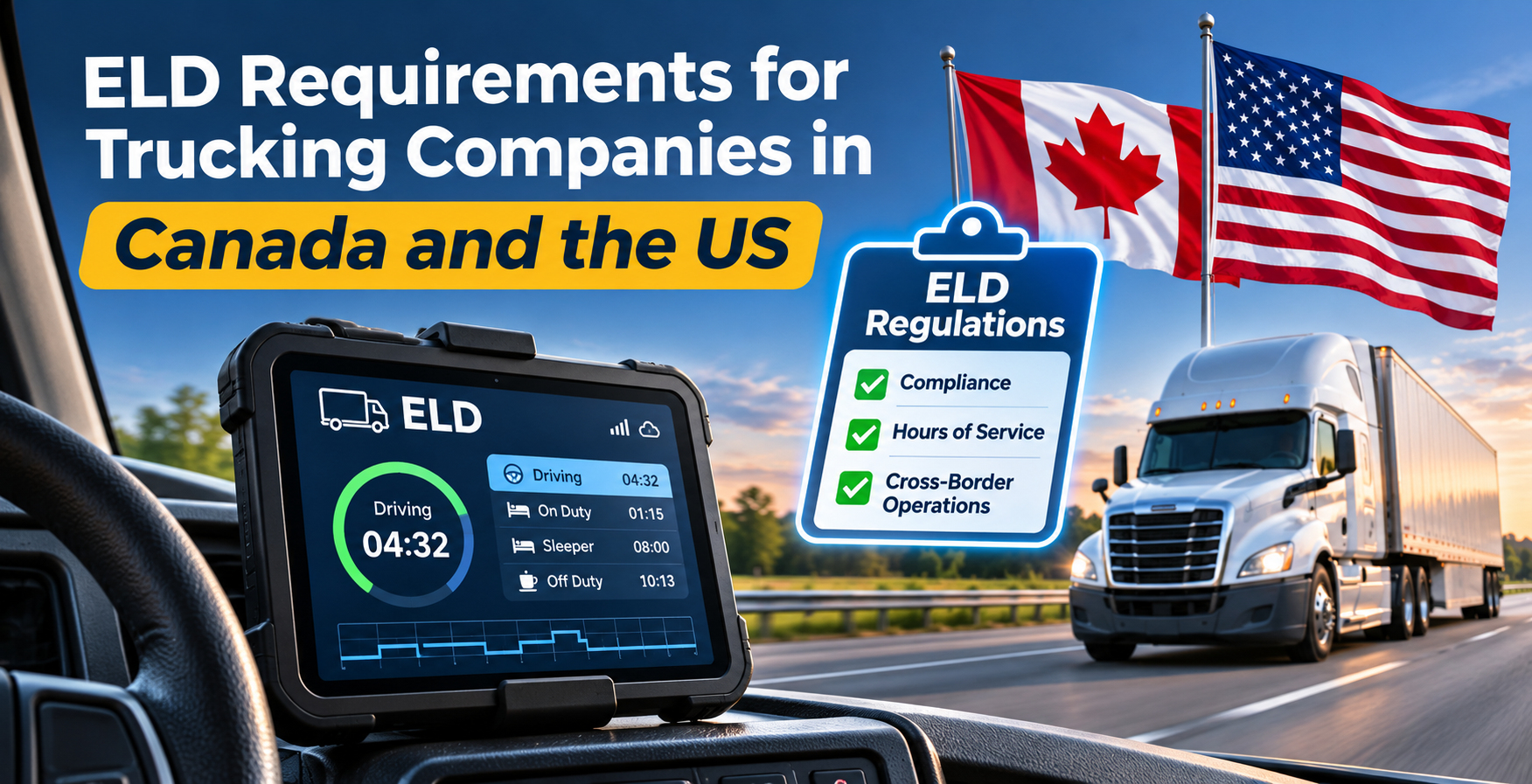
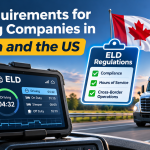
ELD Requirements for Trucking Companies in Canada and the US
- November 3, 2026
- AVAAL Technology Solutions
Electronic Logging Devices, better known as ELDs, have become a standard part of trucking operations across Canada and the United States.
For carriers, an ELD is more than a device that records driving hours. It is an important compliance tool that helps drivers maintain accurate Hours of Service records, helps fleet managers monitor available driving time and makes roadside inspections easier.
However, Canadian and U.S. ELD requirements are not exactly the same.
That difference becomes especially important for trucking companies operating across the Canada-U.S. border. A device that meets U.S. requirements may not automatically meet Canadian requirements.
This guide explains the major ELD requirements for trucking companies in Canada and the United States, the differences carriers should know and how fleet management software can make ELD information easier to manage. This guide is general information, not legal advice. Confirm current requirements with Transport Canada, your provincial regulator or FMCSA before making compliance decisions.
What Is an Electronic Logging Device?
An Electronic Logging Device is equipment connected to a commercial vehicle that automatically records driving activity.
An ELD typically synchronizes with the vehicle’s engine to record information such as:
- driving time
- engine hours
- vehicle movement
- distance travelled
- date and time
- location
- driver duty status
The primary purpose of an ELD is to help drivers and trucking companies maintain accurate Records of Duty Status (RODS) and comply with Hours of Service regulations.
Instead of manually recording every change in duty status on a paper logbook, drivers can use an ELD to maintain much of the information electronically.
For carriers, this can mean fewer paperwork errors, better visibility into driver hours and a more organized compliance process.
ELD Requirements in Canada
Canada’s federal ELD requirements apply to federally regulated commercial motor carriers and drivers who are required to maintain Records of Duty Status under the Commercial Vehicle Drivers Hours of Service Regulations.
Federal trucking jurisdiction generally covers extra-provincial carriers that transport goods or passengers across provincial or international boundaries.
For federally regulated operations, using a compliant ELD is a legal requirement unless the driver or vehicle falls under an applicable exemption.
Which Commercial Vehicles Are Covered by Canada’s ELD Rules?
Transport Canada identifies the federal ELD requirements as applying to covered commercial vehicles such as:
- trucks, tractors, trailers or combinations with a registered gross weight greater than 4,500 kg
- buses designed and built to transport more than 10 people, including the driver
The driver must also be subject to the applicable Hours of Service and RODS requirements.
Carriers operating only within one province should also check the rules of that province or territory, since intraprovincial transportation can be subject to provincial requirements.
Canada Requires Third-Party-Certified ELDs
One of the most important differences between Canadian and U.S. ELD rules involves certification.
In Canada, an ELD cannot simply be declared compliant by its manufacturer.
Both ELD hardware and software-based systems must be tested and certified by an independent certification body accredited by the Minister of Transport.
Transport Canada maintains a list of certified devices that meet Canadian requirements.
This means fleet owners should not assume that any ELD marketed in North America is acceptable for use in Canada.
Before purchasing an ELD, verify that the specific device and software version are approved for Canadian use.
ELD Exemptions in Canada: Who May Not Need an ELD?
Transport Canada identifies several circumstances where a driver may operate without an ELD.
These include situations where the driver:
- works for a motor carrier operating under an applicable permit
- works for a carrier that has received an exemption under the Motor Vehicle Transport Act
- is operating a vehicle rented under an agreement of 30 days or less that is not an extended or renewed rental of the same vehicle
- is operating a pre-2000 model year vehicle
- is not required to maintain a Record of Duty Status
The details surrounding exemptions matter, so carriers should not assume that a general exemption applies without checking the specific regulation.
ELD Requirements in the United States
In the United States, the federal ELD rule is administered by the Federal Motor Carrier Safety Administration, or FMCSA.
The ELD requirement generally applies to most motor carriers and commercial vehicle drivers who are required to maintain Records of Duty Status under 49 CFR Part 395.
That distinction is important.
Not every commercial truck automatically requires an ELD. The requirement largely depends on whether the driver is required to maintain RODS under federal Hours of Service regulations.
Who Is Generally Required to Use an ELD in the US?
Most drivers who regularly maintain RODS under federal Hours of Service regulations must use a compliant ELD.
The rule applies to trucks as well as commercial buses and also applies to qualifying Canada- and Mexico-domiciled drivers while operating under U.S. regulations.
Major US ELD Exceptions
The FMCSA provides several limited exceptions to the ELD requirement.
They include:
- drivers operating under qualifying short-haul exceptions who do not need to maintain RODS
- drivers who are required to maintain RODS for no more than 8 days during any 30-day period
- certain driveaway-towaway operations where the vehicle being driven is part of the shipment, including motor homes and recreational vehicle trailers
- qualifying vehicles manufactured before model year 2000
These drivers may still be subject to other Hours of Service and recordkeeping requirements even when an ELD itself is not mandatory.
On October 2, 2026, FMCSA issued updated guidance on the pre-2000 exception covering glider kits and engine swaps. A vehicle running an engine older than model year 2000 can qualify even when its VIN shows a later year, provided the carrier keeps documentation of the engine change.
Canada vs. US ELD Mandate: Key Differences
Although both countries use ELDs to support Hours of Service compliance, there are several important differences.
| Requirement | Canada | United States |
| Primary regulator | Transport Canada / applicable jurisdictions | FMCSA |
| ELD approval | Third-party certification required | Manufacturer self-certification and FMCSA registration |
| Main applicability | Federally regulated drivers required to maintain RODS | Most drivers required to maintain RODS under Part 395 |
| Pre-2000 exemption | Generally available | Generally available |
| Short-term rental exemption | Certain rentals of 30 days or less | Rentals of 8 days or less under a temporary FMCSA exemption, with paper logs |
| ELD malfunction repair period | Generally 14 days, subject to specific circumstances | Generally 8 days |
| Cross-border consideration | Canadian-certified ELD required while subject to Canadian mandate | FMCSA-registered device required while subject to U.S. rule |
The certification difference deserves particular attention.
In the United States, ELD providers self-certify that their devices meet federal technical requirements and register them with FMCSA. FMCSA maintains a list of registered devices but notes that the devices on the list are self-certified by their manufacturers.
Canada takes a different approach by requiring devices to undergo third-party certification through an accredited certification body.
What Do Cross-Border Trucking Companies Need to Know?
If your trucks regularly travel between Canada and the United States, ELD compliance requires additional attention.
One common mistake is assuming that an ELD approved for U.S. operations will automatically be acceptable in Canada.
That is not necessarily true.
Transport Canada states that U.S.-based motor carriers and drivers operating under the Canadian ELD requirements must use devices that meet Canada’s regulations and technical standard.
A device can comply with both U.S. and Canadian requirements, but for Canadian operation it must meet Canada’s certification requirements.
For fleets that operate frequently on both sides of the border, choosing a system designed to support both regulatory environments can make operations much easier.
Do US ELD Exemptions Apply in Canada?
Carriers should be particularly careful here.
A driver who qualifies for an ELD exemption in the United States should not automatically assume that the same exemption will apply after crossing the Canadian border.
Transport Canada specifically notes that U.S. exemptions, such as certain agricultural exemptions, are not automatically recognized in Canada.
Cross-border carriers should therefore check compliance requirements based on the country in which the vehicle is operating.
What Happens If an ELD Malfunctions?
ELD problems happen.
A device can lose connectivity, experience a hardware failure or generate a diagnostic or malfunction event.
The important thing is knowing what the driver and carrier are expected to do.
ELD Malfunctions in Canada
If a Canadian ELD is not working correctly, the driver should notify the motor carrier and switch to paper daily logs when required.
Transport Canada states that the carrier generally needs to repair or replace the malfunctioning ELD within 14 days, or once the driver returns to the carrier’s home terminal if the trip lasts longer than 14 days.
The driver must also record information relating to the malfunction in their RODS.
ELD Malfunctions in the United States
U.S. requirements are different.
FMCSA states that a driver must notify the carrier in writing about an ELD malfunction within 24 hours.
When the malfunction prevents proper recording or presentation of Hours of Service information, drivers may need to reconstruct their RODS and continue maintaining paper logs while the device is being repaired.
The motor carrier generally has 8 days to repair, service or replace the malfunctioning ELD. A longer period requires an FMCSA extension, which the carrier must request within 5 days of the driver’s notice.
This is another reason cross-border fleets should train drivers on the requirements of both countries.
How Long Should ELD Records Be Kept?
Record retention is an important part of ELD compliance.
Having an ELD does not remove a carrier’s obligation to properly retain Hours of Service information and supporting records.
In the United States, motor carriers are generally required to retain ELD RODS and supporting documentation for six months. FMCSA also requires backup ELD records to be maintained separately from the system holding the original records.
Transport Canada also requires federally regulated motor carriers to retain RODS and supporting documents for at least six months.
Supporting documentation can include records such as:
- bills of lading
- fuel receipts
- dispatch records
- trip documents
- payroll or settlement records
- vehicle repair information
- location records
- shipment schedules
Keeping this information organized can make audits and compliance reviews considerably easier.
What Should Drivers Carry in the Truck?
An ELD system is not simply installed and forgotten.
Drivers need to understand how to operate the device and how to present their Hours of Service records during an inspection.
In Canada, Transport Canada states that commercial vehicles should have an ELD information packet containing items such as:
- the current user manual
- instructions for transferring ELD data to an inspector
- instructions explaining what to do during an ELD malfunction
- enough blank RODS for the driver to maintain the required records if the ELD fails
Canadian requirements call for enough blank logs to cover at least 15 days. U.S. rules require blank paper logs for at least 8 days.
Fleet managers should make ELD training part of driver onboarding rather than assuming every driver already understands the system.
An ELD Is More Useful When It Connects With Your Fleet Management System
ELD compliance may begin with Hours of Service, but the information generated by an ELD can also be useful for running the business.
A disconnected ELD means dispatchers may have to open one system to check driver hours, another to dispatch a truck and another to track the shipment.
That creates unnecessary work.
An integrated trucking management system can bring ELD information closer to the rest of the operation.
For example, dispatchers may be able to see driver Hours of Service and truck location while planning or managing trips.
This can help answer practical questions such as:
- Does the driver have enough available hours to complete this load?
- Where is the truck right now?
- Will the driver have enough legal driving time to reach the next stop?
- Which driver is best positioned for a new load?
When ELD information is integrated with dispatch operations, compliance becomes part of daily decision-making instead of a separate task.
How AVAAL Freight Management Helps Connect ELD Data With Operations
AVAAL Freight Management Suite (AFM) is designed to help carriers manage dispatching, trips, accounting, safety, reporting and integrations within one connected freight management platform.
AFM can integrate with API-enabled ELD and telematics providers, including systems such as Motive, Samsara, Geotab, ISAAC and Omnitracs, depending on the integration and configuration used.
With ELD integration, trucking companies can bring ELD and telematics data, including live trip tracking, into their freight management workflow instead of constantly switching between separate systems.
For dispatch teams, this creates a more complete picture of what is happening across the fleet.
Instead of planning a trip based only on whether a truck appears available, dispatchers can work with additional information about the driver, vehicle and trip.
AVAAL Freight Management also provides tools for:
- load and order management
- dispatching and trip planning
- driver and truck management
- safety and compliance management
- document management
- accounting and invoicing
- IFTA reporting
- route planning
- driver and dispatch mobile apps
- ELD and telematics integrations
For trucking companies operating in both Canada and the United States, bringing compliance information and freight operations together can reduce unnecessary administrative work and provide better visibility across the fleet.
Learn more about AVAAL Freight Management and how ELD integration brings fleet data into your everyday dispatch operations.
ELD Compliance Checklist for Trucking Companies
Before sending trucks on the road, fleet managers should regularly review their ELD setup.
A practical checklist includes confirming that:
- Your drivers actually require an ELD.
Determine whether each operation is subject to RODS and ELD requirements and whether a valid exemption applies. - Your device is approved for the country where the truck operates.
Canadian fleets should verify Canadian third-party certification. U.S. fleets should confirm that the ELD appears on FMCSA’s registered-device list. - Cross-border trucks use appropriate equipment.
Do not assume U.S. compliance automatically equals Canadian compliance. - Drivers know how to use the ELD.
They should understand logins, duty-status changes, annotations, certifications and inspection procedures. - Drivers know what to do when an ELD fails.
Paper-log procedures and notification requirements should be part of your company’s training. - Required documents are available in the vehicle.
Manuals, transfer instructions, malfunction instructions and backup logs should be readily accessible where required. - Driver records are reviewed.
Regularly monitor unidentified driving, edits, diagnostic events and Hours of Service violations. - Records are properly retained.
Keep ELD and supporting documentation for the required retention period. - ELD data is connected to operations where practical.
Integrating your ELD with your trucking management software can improve visibility and reduce duplicate work.
Frequently Asked Questions About ELD Requirements
Are ELDs mandatory in Canada?
ELDs are mandatory for federally regulated commercial motor carriers and drivers who fall under the applicable Hours of Service and RODS requirements, unless an exemption applies. Canadian rules also require qualifying ELDs to be independently certified by an accredited certification body.
Are ELDs mandatory in the United States?
Most drivers who are required to maintain Records of Duty Status under FMCSA Hours of Service regulations must use a registered ELD unless they qualify for an exception.
Do owner-operators need an ELD?
Many owner-operators do, but the answer depends on their operation.
An owner-operator who is required to keep RODS and does not qualify for an exemption will generally need a compliant ELD. Being a one-truck business does not by itself create an exemption.
Can I use the same ELD in Canada and the United States?
Yes, a device can be designed to comply with the requirements of both countries.
However, fleets should verify that the specific product meets Canada’s certification requirements and is also properly registered for U.S. operation when applicable.
Does an FMCSA-approved ELD automatically work for Canada?
Not necessarily.
U.S. ELD providers self-certify and register their systems with FMCSA, while Canada requires third-party certification. A cross-border carrier should confirm that its particular ELD is compliant in both countries.
Are older trucks exempt from ELD requirements?
Both countries provide certain exceptions involving pre-2000 vehicles, although the exact rules and circumstances should be checked carefully.
In the United States, FMCSA issued revised guidance on October 2, 2026 explaining how the pre-2000 model-year exception can apply to vehicle and engine configurations.
How long can a driver use paper logs if an ELD breaks?
The rules differ between countries.
In the United States, the carrier generally has eight days to repair, service or replace the malfunctioning ELD unless FMCSA grants an extension requested within 5 days of the driver’s notice.
In Canada, the carrier generally has 14 days, or until the vehicle returns to its home terminal when a qualifying trip lasts longer than 14 days.

- November 13, 2026
- November 3, 2026

- October 26, 2026

- December 15, 2025


- December 19, 2024


- May 10, 2024
