



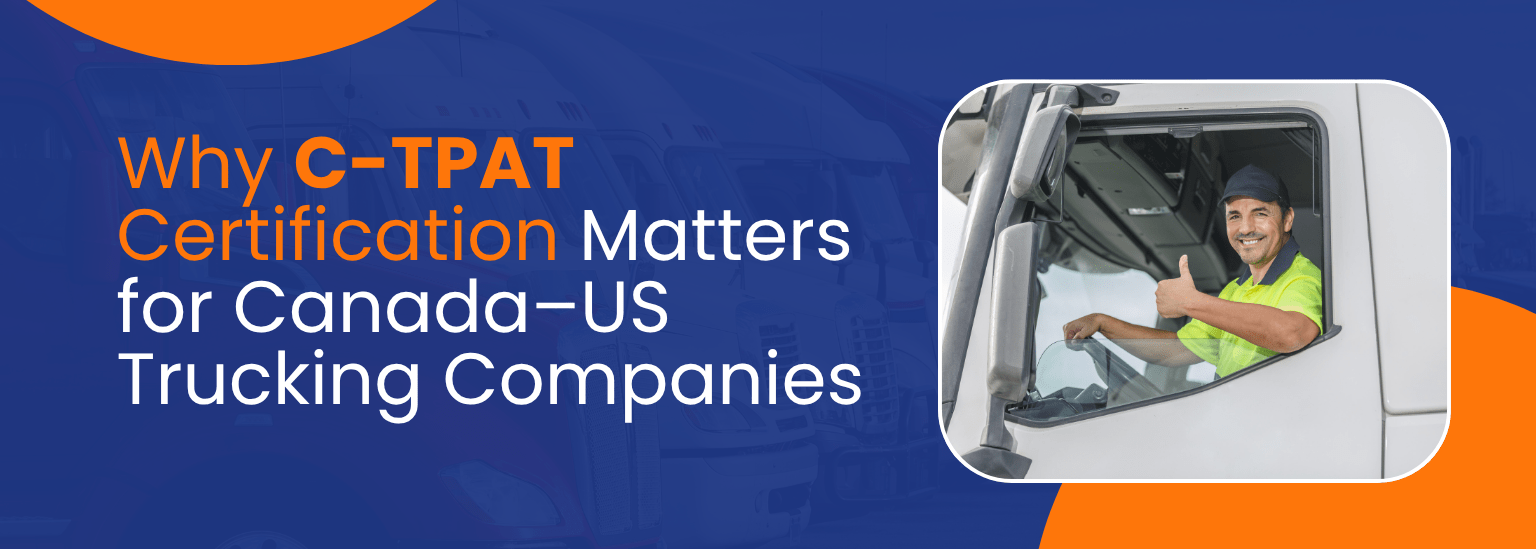
Why C-TPAT Certification Matters for Canada–US Trucking Companies
- July 3, 2026
- AVAAL Technology Solutions
Key takeaways
- C-TPAT is a voluntary supply chain security program run by U.S. Customs and Border Protection that designates trusted carriers as lower risk.
- Certified carriers generally clear the border faster, face fewer cargo inspections, and can access FAST lanes at eligible Canada–US crossings.
- Certification is increasingly a requirement to win shipper and manufacturer contracts, not just a nice-to-have.
- The certification clock belongs to CBP, but the preparation timeline is where carriers win or lose months. With 20+ years of cross-border experience, AVAAL gets your application submission-ready in days.
- AVAAL guides carriers through eligibility, gap analysis, documentation, and validation readiness, end to end.
Cross-border trucking is more competitive than ever. Customers expect on-time deliveries, border delays ripple straight through delivery schedules, and supply chain security is now a priority for government agencies and shippers alike.
For carriers moving freight between Canada and the United States, certification under the Customs Trade Partnership Against Terrorism, known as C-TPAT, is a concrete competitive advantage. It improves border efficiency, builds customer trust, and strengthens compliance at the same time.
If your company regularly crosses the Canada–US border, this guide explains what C-TPAT certification involves, what it delivers, and how AVAAL helps you earn it.
What Is the Customs Trade Partnership Against Terrorism?
C-TPAT is a voluntary supply chain security program administered by U.S. Customs and Border Protection. It was created to strengthen international trade security by partnering with businesses that demonstrate strong security practices across their operations.
Instead of relying only on border inspections, the program asks companies to actively identify risks, secure their facilities, protect cargo, and maintain safe transportation processes. For a trucking company, certification signals a documented commitment to secure cross-border transportation and helps reduce disruptions at the border.
Why Should Trucking Companies Become C-TPAT Certified?
Every border delay affects delivery schedules, fuel costs, driver productivity, and customer satisfaction. C-TPAT certification reduces those pressures by making your company a trusted transportation partner. The main benefits follow.
Faster Border Crossings
Certified carriers are generally treated as lower risk by U.S. Customs and Border Protection, so shipments are less likely to face unnecessary delays during customs processing. For a carrier crossing several times a week, even small per-trip savings compound into meaningful productivity gains.
Fewer Cargo Inspections
Inspections are never fully eliminated, but certified carriers generally experience fewer examinations than non-certified ones. Fewer inspections mean less waiting at ports of entry, fewer unexpected delivery delays, lower detention and storage costs, and more reliable schedules.
Access to FAST Lanes
One of the most valuable benefits for eligible carriers is access to Free and Secure Trade, or FAST, lanes at participating Canada–US crossings. FAST expedites processing for qualified shipments when the carrier, driver, and importer all meet program requirements. For carriers making frequent crossings, the time savings are substantial.
Stronger Customer Trust
Many manufacturers, importers, and logistics providers prefer certified carriers because they follow recognized supply chain security standards. Certification proves your business has procedures in place to protect freight from theft and tampering, which becomes a real selling point when bidding on new contracts.
Improved Supply Chain Security
The certification process pushes carriers to strengthen internal operations through best practices for trailer and cargo security, facility security, driver identification, visitor management, employee screening, cybersecurity, security awareness training, and business partner verification. These measures satisfy program requirements while reducing operational risk and cargo theft.
Is Your Trucking Company Eligible?
Canadian and US highway carriers that regularly transport commercial freight across the international border may be eligible. Applicants must be active cross-border carriers and meet the minimum security criteria established for highway carriers.
If you are unsure whether your business qualifies, AVAAL can review your operations and confirm eligibility before you apply for C-TPAT certification.
How Long Does It Take to Be C-TPAT Certified?
Part of the timeline is outside anyone’s control. Once a complete application and supply chain security profile are submitted, CBP has up to 90 days to certify your company or reject it, and on-site validation follows within a year of certification. That clock belongs to CBP.
The part you can control is how fast and how well your application is prepared, and that is where most of the calendar is won or lost. Carriers who attempt it alone routinely spend weeks or months assembling policies, closing security gaps, and reworking a security profile that does not yet meet CBP’s Minimum Security Criteria. Every gap and every correction adds delay before the CBP clock even starts.
This is where AVAAL changes the math. With more than 20 years of cross-border experience, we get your application and security profile submission-ready in a matter of days, not months. We know exactly what CBP’s Supply Chain Security Specialists look for, we build your documentation to meet the Minimum Security Criteria the first time, and we manage the process end to end to minimize back-and-forth. The result is the fastest realistic path to certification, with the least disruption to your operation and the lowest risk of rejection.
What Does the Certification Process Involve?
Many carriers assume certification is just an application. In reality, you must demonstrate effective security procedures and document how they are followed.
- Review your current operations. Existing security policies, facilities, drivers, trailers, and processes are evaluated to identify gaps.
- Implement required security measures. Any gaps are closed before the application is submitted.
- Prepare documentation. Policies and procedures must align with the program’s minimum security criteria.
- Complete the application. The application and supply chain security profile are submitted through the CBP portal.
- Validation. After certification, CBP reviews and validates that your company is actually implementing the documented practices.
Common Challenges Carriers Face
Many carriers struggle because they are unsure which security policies are required, lack documented procedures, find the security profile difficult to complete, do not know how to prepare for validation, or are unfamiliar with highway carrier requirements. These gaps delay certification or create rework later. An experienced consultant simplifies the process and reduces costly mistakes.
How AVAAL Helps Carriers Get C-TPAT Certified
We work with trucking companies every day, so we understand the operational reality behind the requirements. Our consultants guide carriers through every stage of certification with confidence.
Our C-TPAT services include eligibility assessment, security gap analysis, development of required policies and procedures, application preparation, supply chain security profile assistance, validation readiness support, and ongoing compliance guidance.
Whether you run a small fleet or manage hundreds of trucks across the Canada–US border, AVAAL provides practical support tailored to your operation.
Why AVAAL Is the Partner to Get You Certified
C-TPAT certification rewards companies that get the details right the first time, and that is exactly what 20+ years in cross-border transportation buys you. AVAAL does not learn the program on your file. We have guided carriers through decades of customs requirements, regulatory compliance, and cross-border operations, and we know precisely what CBP’s Supply Chain Security Specialists expect at every stage.
That experience is the difference between a file that sails through and one that stalls in correction cycles. We close your security gaps, build documentation to the Minimum Security Criteria, prepare you for validation, and manage the whole process so you are not interpreting complex federal requirements on your own. For carriers who need certification done right and done fast, AVAAL is the partner that delivers both.
Get C-TPAT Certified with AVAAL
Becoming C-TPAT certified is more than a compliance milestone. It is an investment in your reputation, operational efficiency, and long-term growth.
Contact AVAAL today to learn how our C-TPAT specialists can help you strengthen supply chain security, reduce border delays, and gain a competitive edge in cross-border transportation.
Frequently Asked Questions
How long does it take to be C-TPAT certified?
CBP has up to 90 days to certify after a complete application and security profile are submitted, with validation within a year. The bigger variable is preparation. AVAAL’s 20+ years of experience gets your application submission-ready in days rather than months, built to meet CBP’s criteria the first time so the file moves without rework.
Does C-TPAT guarantee my trucks will never be inspected?
No. Inspections are never fully eliminated. Certified carriers are treated as lower risk and generally face fewer examinations than non-certified carriers.
What is the difference between C-TPAT and FAST?
C-TPAT is the security certification. FAST is an expedited border-processing benefit available at participating Canada–US crossings when the carrier, driver, and importer all qualify.
Can a small fleet get certified?
Yes. Carriers of any size can apply, provided they are active cross-border highway carriers and meet the minimum security criteria.
How can AVAAL help with certification?
AVAAL handles eligibility assessment, security gap analysis, policy development, application preparation, and validation readiness, so you can certify efficiently and avoid rework.
- October 23, 2026

- October 9, 2026

- December 15, 2025


- December 19, 2024


- May 10, 2024
